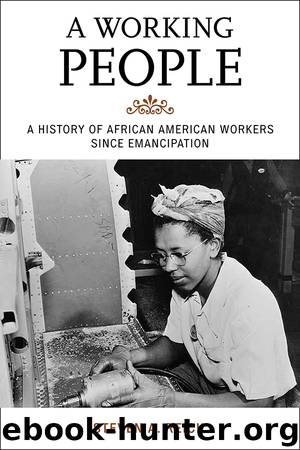
A Working People by Steven A. Reich
Author:Steven A. Reich [Reich, Steven A.]
Language: eng
Format: epub
Publisher: Rowman & Littlefield Publishers
Published: 2013-04-24T23:00:00+00:00
Chapter Five
The Black Working-Class Movement for Civil Rights
On the eve of the 1963 March on Washington for Jobs and Freedom, the occasion at which Martin Luther King delivered his famous “I Have a Dream” speech, a national poll asked African Americans how discrimination had personally affected them. More respondents replied that they had suffered job and wage discrimination rather than discrimination in restaurants. The pollsters also found that six out of ten African Americans worked either in menial unskilled jobs, domestic or personal service, or were out of work. When pollsters asked blacks what jobs they would like to have for which they believe themselves qualified, eight out of ten aspired to jobs as skilled laborers, professionals, business executives, or white-collar workers. To the pollsters, these numbers clarified the obstacles that prevented most African Americans from enjoying the fruits of American postwar prosperity. Although 90 percent of African American homes owned a television set, television exposed the material comforts that whites freely enjoyed—suburban homes, modern appliances, new automobiles, and manicured lawns—but that remained elusive for most blacks. To attain a share of that prosperity, the pollsters argued, blacks needed better-paying jobs. To qualify for such jobs, blacks needed better education, which required that they live in neighborhoods that supported good public schools. But to live there, they needed the money to afford decent housing.
As the national poll revealed, African Americans regarded economic justice as the central demand, if not dream, of the civil rights movement. While African Americans carried on a vigorous fight for school desegregation, access to public accommodations, and the right to vote during the civil rights movement of the 1950s and 1960s, they never abandoned the struggle for economic equality or dismissed unions as irrelevant to their quest for just, fair, and full employment. Most African Americans adhered to a vision of civil rights that combined access to good jobs, an end to employment discrimination, the desegregation of public space, and the right to vote. As Gloria Richardson, a community activist in Cambridge, Maryland, recognized in 1963, segregated lunch counters, schools, and buses were merely symbolic of the deeper indignities that African Americans endured. Economic questions remained central, and African Americans regarded unions, despite their flaws, as relevant institutions for waging the struggle for the economic foundation of citizenship.
Download
This site does not store any files on its server. We only index and link to content provided by other sites. Please contact the content providers to delete copyright contents if any and email us, we'll remove relevant links or contents immediately.
International Integration of the Brazilian Economy by Elias C. Grivoyannis(111057)
The Radium Girls by Kate Moore(12028)
Turbulence by E. J. Noyes(8047)
Nudge - Improving Decisions about Health, Wealth, and Happiness by Thaler Sunstein(7706)
The Black Swan by Nassim Nicholas Taleb(7129)
Rich Dad Poor Dad by Robert T. Kiyosaki(6632)
Pioneering Portfolio Management by David F. Swensen(6300)
Man-made Catastrophes and Risk Information Concealment by Dmitry Chernov & Didier Sornette(6019)
Zero to One by Peter Thiel(5801)
Secrecy World by Jake Bernstein(4752)
Millionaire: The Philanderer, Gambler, and Duelist Who Invented Modern Finance by Janet Gleeson(4478)
The Age of Surveillance Capitalism by Shoshana Zuboff(4292)
Skin in the Game by Nassim Nicholas Taleb(4248)
The Money Culture by Michael Lewis(4207)
Bullshit Jobs by David Graeber(4190)
Skin in the Game: Hidden Asymmetries in Daily Life by Nassim Nicholas Taleb(4004)
The Dhandho Investor by Mohnish Pabrai(3764)
The Wisdom of Finance by Mihir Desai(3746)
Blockchain Basics by Daniel Drescher(3581)
